
Ghost Kitchen vs Food Truck: Costs, Margins & Which to Pick
 Ali Tanis16 min read
Two people with the same $60,000 and the same recipe end up in opposite businesses. One buys a vehicle and parks it where the crowd is. The other leases a corner of a shared kitchen and waits for a screen to light up. A third does both, which is what people mean by a ghost kitchen food truck.
The choice gets framed as a budget question. It isn't. It's about which risk you can live with for five years.
Quick Summary: A food truck costs $50,000-$200,000 to launch and earns visibility you never pay a platform for, but permits average $28,276 in year one and winter strips 20-35% off revenue. A ghost kitchen starts at $5,000-$40,000 and opens in weeks, then surrenders 15-30% of every ticket forever. Below roughly 38 orders a day the delivery route wins on math; above it, the vehicle does.
The Short Answer
A truck buys visibility and charges you for it up front. A ghost kitchen buys a cheap start and charges you for it forever. That one trade decides almost everything else here.
Put a vehicle on the street and you own an asset that markets itself every time it parks. You also own fuel, maintenance, a permit file in every city you enter, and a business that earns nothing when it rains.
Open a ghost kitchen and you skip all of that. You also hand 15% to 30% of every ticket to delivery services that own your discovery, your ranking, and the customer relationship.
Neither is genuinely cheaper. One is a fixed cost that stops growing; the other is a percentage that grows with your success. Where those lines cross is the real decision.
Ghost Kitchen vs Food Truck at a Glance
| Ghost kitchen | Food truck | |
|---|---|---|
| Startup capital | $5,000-$40,000 | $50,000-$200,000 |
| Time to launch | 2-6 weeks | 4-9 months |
| Monthly overhead | $0-$15,000 rent | $5,000-$10,000 burn |
| Cost per sale | 15-30% commission | ~3% card processing |
| Discovery | Platform ranking only | Footfall, events, social |
| Permits | Mostly the landlord's | 45 procedures, $28,276 year one |
| Crew | 2-4 cooks and packers | 2-3 who cook and sell |
| Weather | Rain lifts sales | Rain kills the day |
| Resale asset | Recipes and a listing | A resaleable vehicle |
| Growth lever | Add virtual restaurants | Events, catering, second unit |
Almost every row where one column looks like a win is where it takes on a hidden obligation.
Startup Cost: What You Actually Write Cheques For
Used food trucks run $40,000-$85,000 in 2026. A new custom build is $90,000-$175,000, a towable trailer $37,000-$80,000. Add $3,000-$5,000 of opening inventory and $10,000-$20,000 of working capital and the all-in figure is $85,000-$120,000. Used vehicle prices are up 15-20% since 2022, so older guides understate this.
Ghost kitchens split into three tiers, nothing alike:
- A virtual restaurant run from a kitchen you already pay for: $5,000-$15,000. No new lease, no new equipment. The cheapest legitimate entry into foodservice.
- Time in a shared commissary: $20,000-$40,000, then $15-$50 an hour for kitchen space.
- A private unit in a managed facility: $40,000-$80,000, then $3,000-$15,000 a month.
Here's what the cost tables leave out. A vehicle is collateral; a commissary agreement is not. Fail in month nine and you leave with recipes, packaging, and a listing that stops existing the moment you stop paying. Mobile operations risk more money, but less of it evaporates.
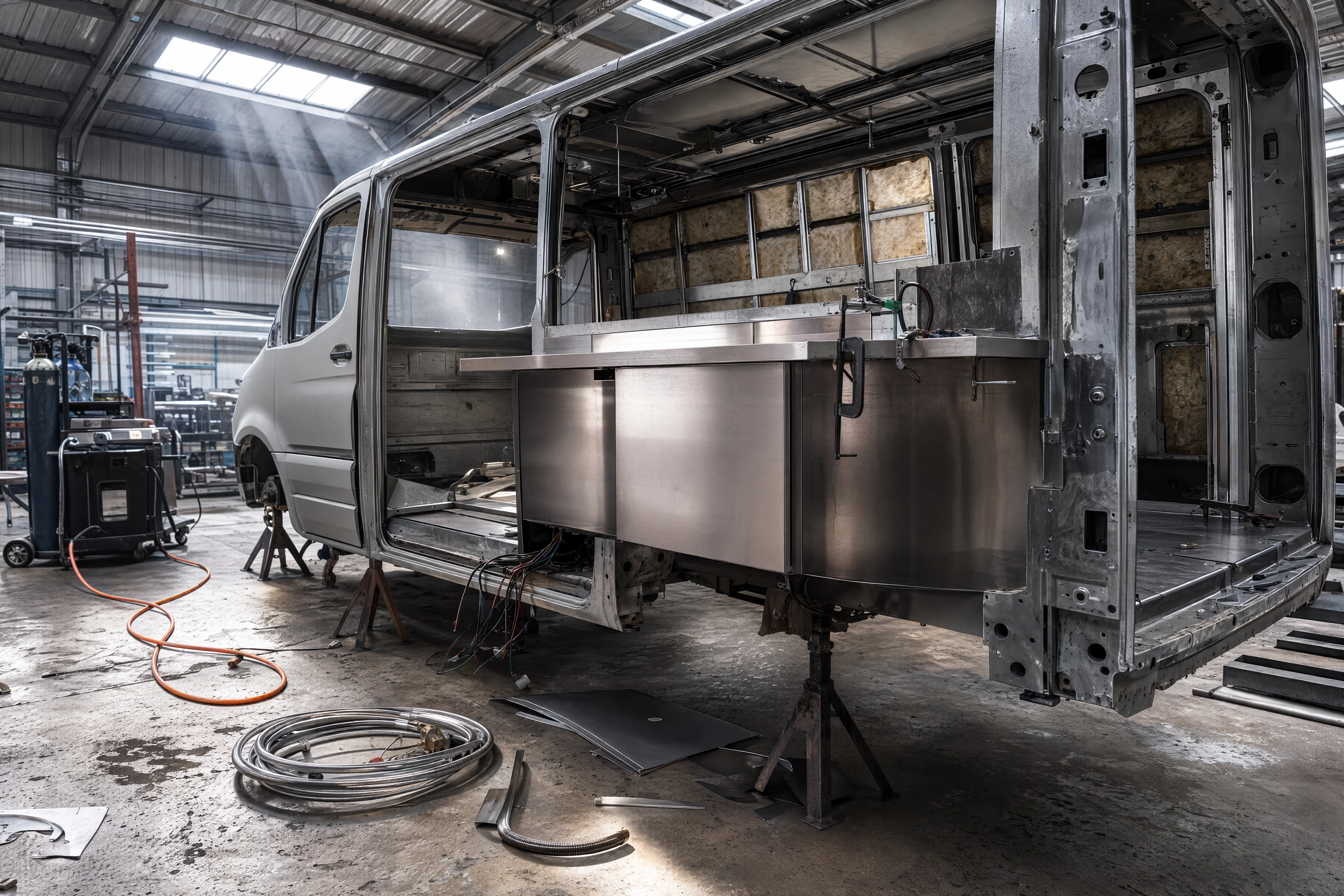 Stripped food truck shell on jack stands mid build-out in a fabrication workshop showing where startup capital goes
Ongoing Overhead: Fixed Cost vs a Percentage of Everything
A mobile operator's monthly burn usually sits between $5,000 and $10,000: fuel, commissary fees, insurance, permits, maintenance, propane. Food and paper land at 25-28% of sales, card processing about 3%.
Now the other side. In 2026, DoorDash runs three marketplace plans at 15%, 25%, and 30% commission, with pickup near 6%. Uber Eats mirrors that band, having lifted its entry tier from 15% to 20% and charging up to 30% on member orders. Grubhub starts lower and climbs once marketing is bundled in. Add promotions and refunds and the effective take from third-party delivery services often reaches 30-40%.
To net the same on a marketplace order as in person, mark the item up by commission ÷ (1 − commission):
- 15% commission needs a 17.6% markup
- 25% commission needs a 33.3% markup
- 30% commission needs a 42.9% markup
That last line is why so many ghost kitchen menus look expensive. They aren't greedy. They're solvent.
Where the two lines cross
Take a $28 average ticket. A ghost kitchen on a 25% plan gives up $7 an order and pays little fixed rent. A mobile unit gives up about $0.84 in processing and carries roughly $7,000 a month in fixed costs.
Divide $7,000 by the $6.16 difference and you get about 1,136 tickets a month — near 38 orders a day. Below that, third-party delivery is genuinely cheaper. Above it, the fixed-cost route pulls ahead and keeps pulling. Most ghost kitchens need 50+ orders a day to break even, which shows how narrow the gap is.
Where Customers Come From: A Corner vs a Radius
Street demand is geographic and time-boxed. You move to where hungry people already stand — an office park at noon, a brewery at seven, a festival on Saturday. If a location stops working, you drive somewhere else. Nobody can delist you.
Ghost kitchen demand is algorithmic. Your radius is drawn by a platform, your placement depends on a ranking you don't control, and a policy change can halve your volume overnight. You aren't choosing a corner — you're leasing a slot.
The customer relationship splits the same way, and so does what you learn about your customers. A vendor who serves one lunch queue for a year knows faces, names, and orders. A ghost kitchen knows a first name and a drop-off address.
Survivable, but only if you build a direct channel on purpose. Serious operators push customers toward online ordering they own — the only customer list third-party delivery services can't switch off. Our guide to more orders on Uber Eats covers the levers that move volume.
 Aerial night view of a lit residential neighbourhood with one courier scooter light, showing a ghost kitchen delivery radius
Permits, Licensing and the Commissary Rule
The U.S. Chamber of Commerce Foundation's Food Truck Nation study found that starting and running one vehicle for a year takes 45 government-mandated procedures across 37 business days, and costs an average of $28,276 in permits, licences, and compliance.
City variation is brutal: administrative permitting ran near $811 in Denver against roughly $17,066 in Boston. Two identical concepts can face a five-figure gap on postcode alone, so check your fee schedule early. The SBA licence and permit guide maps the process; the FDA Food Code explains the framework your inspector applies.
Ghost kitchens inherit most of this. Lease a licensed commissary and the hood certification, grease trap, and facility inspection already exist. You still need a business licence and food handler certification, but you're joining a compliant location rather than creating one.
Then there's the rule that links the two worlds. Most jurisdictions require a mobile vendor to hold a commissary or approved base of operations for prep, water, waste, and servicing. So most street operators already pay for a licensed kitchen used a few hours a day.
Staffing: Two People in a Box vs a Line Nobody Sees
A service window crew does three jobs at once in about 60 square feet: cook, sell, take payment, usually beside a fryer in August. Half the role is hospitality, which makes it harder to hire for than a cook's job.
Ghost kitchen operations delete the selling job. No hosts, no servers, no counter, no upsell. Staff are cooks and packers, the bar is consistency under ticket pressure, and the labour pool is deeper.
In year one, most mobile operations can't run without the owner in the window. Ghost kitchens are easier to step away from — the work repeats and nobody sees who's cooking.
Weather, Seasonality and Which Risk You Can Survive
Street trade swings harder than first-year operators expect. May through August runs 25-30% above the annual average; November through February runs 20-35% below it. Campus-adjacent vendors lose 60-80% of volume over academic breaks, and food trucks built around the festival circuit can earn most of the year inside five months.
That's survivable with reserves and fatal without them. Build the plan in June for the January you know is coming.
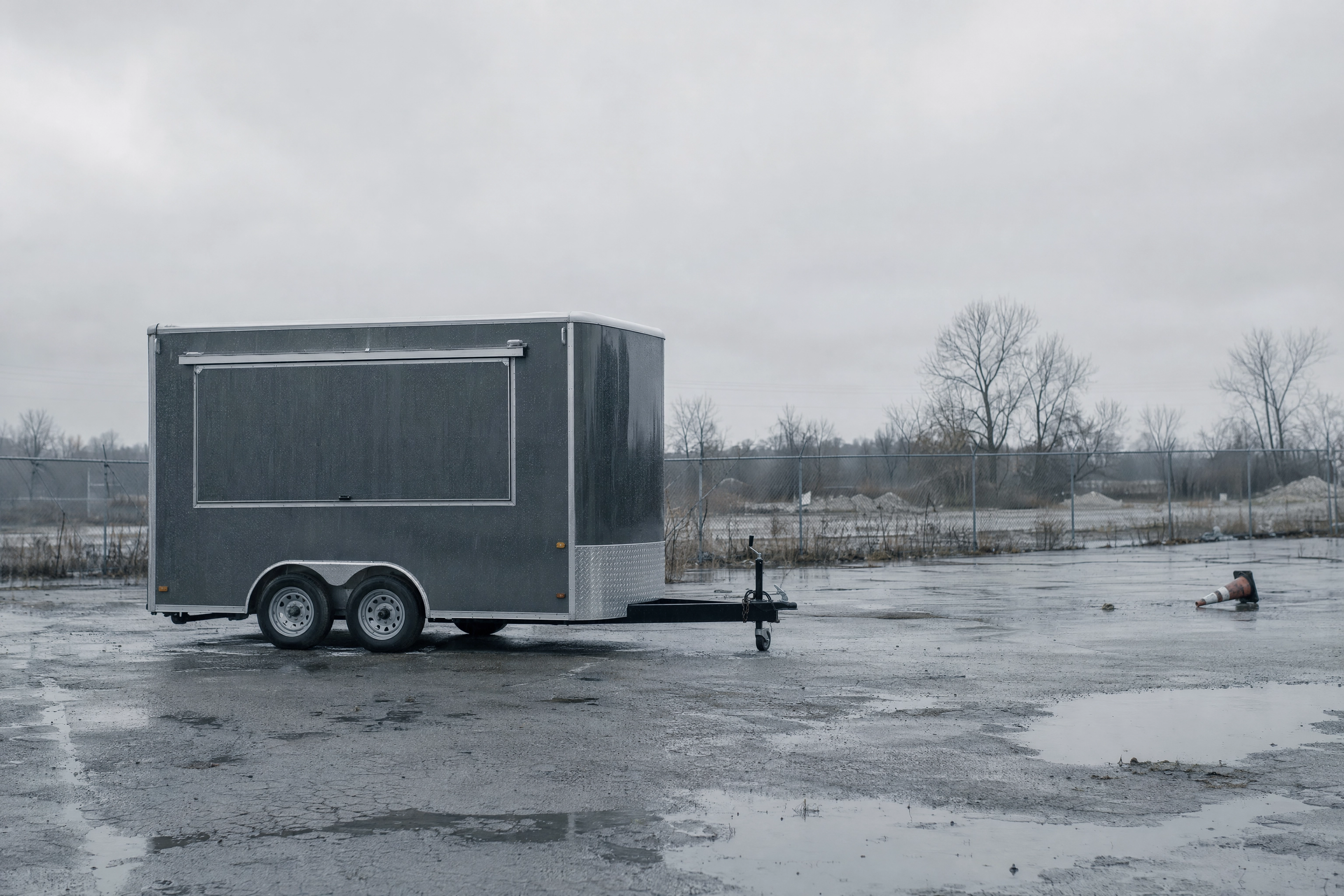 Shuttered food trailer alone on a wet empty lot in flat grey winter light, showing food truck seasonality risk
Ghost kitchen demand moves the other way: rain, cold, and darkness are the conditions that make customers order in. The weather that empties a lunch queue fills a delivery kitchen. That inverse relationship is the strongest argument for running both.
Brand Visibility: A Rolling Billboard vs an Invisible Kitchen
A liveried vehicle is advertising that works parked, driving, and queued. Every service creates impressions you never bought, compounding into a name people recognise and a business a buyer will pay for. Our food truck marketing guide covers how operators convert presence into a following.
Ghost kitchens generate no impressions they haven't paid for. No signage, no passer-by, no accidental discovery. Customers meet you as one tile among forty and decide in a second. That isn't a problem you can outrun with hustle — it's the format.
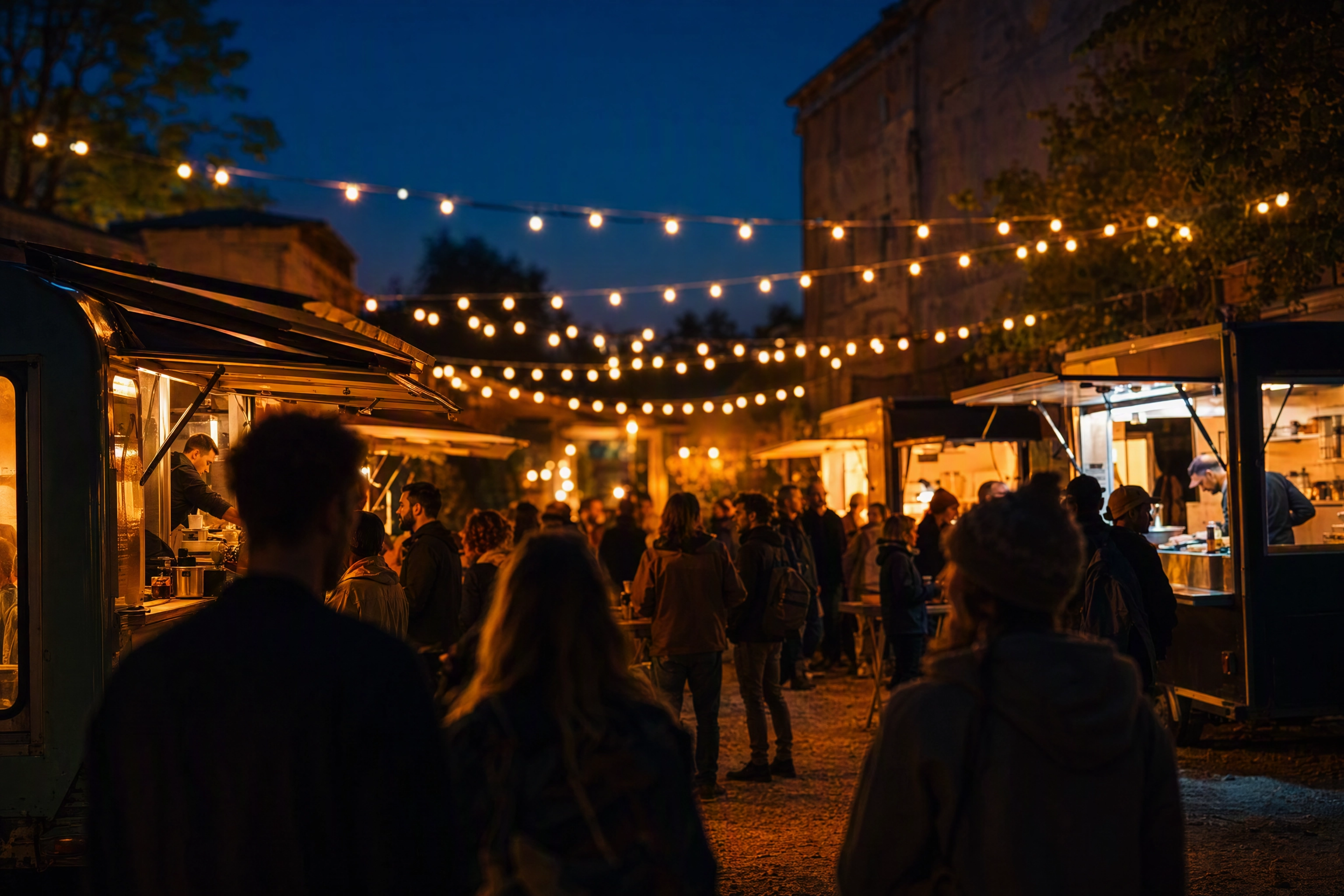 Row of mobile food kitchens lit at night under festoon bulbs with a crowd, showing food truck brand visibility
The consequence is an asset gap. Sell a recognised local business and you're selling a vehicle, a following, and a route book. Sell a virtual restaurant and you're selling recipes plus a listing that may not transfer. A distinct bet, not a worse one. Our ghost kitchen photography page covers how operators build a recognisable brand when the storefront is a thumbnail.
The Growth Ceiling: How Far Each Model Scales
Both models hit a wall, but different ones. A service window caps out at roughly one transaction every 45-90 seconds, limited by hours and by how many good pitches your city has. Doubling means a second vehicle, crew, and permit stack. Catering is the honest lever: private events pay $1,500-$5,000 a booking, and the strongest operators pull 30-50% of revenue there. Our catering photography page is built for that work.
Ghost kitchens scale in a way street vending can't. One line runs several virtual restaurants from the same walk-in and crew — a wings concept at eleven, a bowls concept at eight, sharing prep. Adding a brand costs a menu, a photo set, and a listing. The franchise route favours them too: you're replicating a process, not a personality.
What the 2023-2025 Shakeout Actually Proved
Restaurant Dive reported that one of the best-known ghost kitchen operators sold or closed all of its physical units and pivoted to software, having already shut its eight grocery-store kitchens — 44% of an 18-unit footprint. Another well-funded player closed its three New York facilities and laid off 53 workers, per WARN filings covered by Commercial Observer.
What failed was the real estate layer, not the cooking model. Speculative kitchen capacity leased to unproven concepts was the bad bet; cooking delivery food from a kitchen already paid for kept working.
One more lesson hides in that example. Several cities classified those parking-lot trailers as mobile food units, forcing commissary rules onto a business that thought it was leasing industrial space.
The Hybrid: Running a Ghost Kitchen Food Truck
Remember the commissary rule. Most mobile vendors already pay for licensed kitchen space they use for a few hours of prep. A ghost kitchen food truck setup puts that idle space to work: same licence, same walk-in, same suppliers, running a virtual restaurant while the window is shut.
The fit is good:
- The seasons are inverted. Your dead months are delivery's strong ones, turning January from a survival month into a normal one.
- The prep overlaps. If one braise and one sauce feed both channels, you add revenue without much extra labour.
- The capital is already spent. No second vehicle, no new lease — you're monetising equipment that sits idle.
- It de-risks the menu. A delivery listing is a cheap laboratory for testing items before they earn a slot on the board.
Where it breaks is predictable. Split attention is the big one: nobody runs a lunch rush and a delivery queue well at once, so the channels need separate hours or people. Packaging is second — food that's perfect over a counter arrives soggy after 30 minutes in a bag. Ticket collisions at peak cost you ratings on both sides.
The r/foodtrucks thread "Before buying a food truck, consider a remote kitchen" is a fair example of operators running the sequence in reverse, proving a concept on third-party delivery first. Test the food where testing is cheap, then buy the vehicle once demand is real.
Planning the delivery half? Ghost kitchen menu planning covers which items survive the drive, and our walkthrough of running a ghost kitchen on DoorDash covers the listing mechanics.
The Photography Job Is Not the Same for Both
Both models live or die on images, because customers judge before they taste. They need opposite things — the part operators get wrong most often.
A truck sells in person. The photo has to work on a printed board read from three metres away in a queue: high resolution, clean backgrounds, colour that survives direct sun. The board sells the upsell; social sells tomorrow's location. Get the menu design right and our food truck photography page covers the rest.
Ghost kitchens sell through one thumbnail. No window, no aroma, no queue — a customer scrolling a marketplace sees a small square and decides. Consistency beats artistry: every item shot the same way, centred, bright, safe to crop square. The exact photo specs differ by app, and getting them wrong means silent rejection.
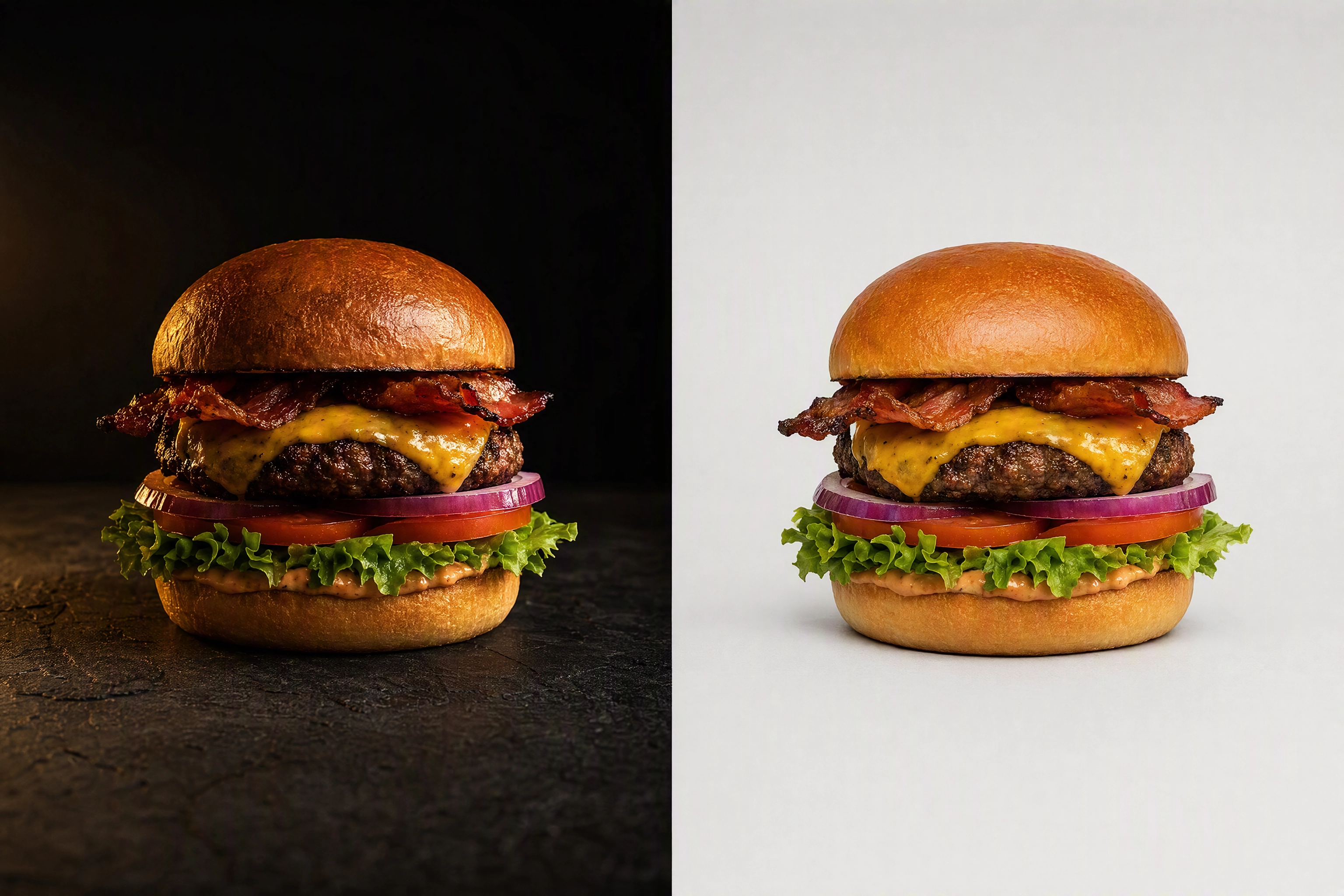 Same burger shot twice in one frame, dramatic side light versus flat even light, showing two food photography briefs
The shared problem is cadence. Both rotate items faster than a photographer's calendar allows — a new special on Thursday, a seasonal dish next month. Restaurants feel that squeeze too, but here it's worse: your menu is the entire storefront.
That's the gap FoodShot AI was built for. Photograph the dish on a phone and get a 2K, menu-ready image in about 2 minutes, with Builder Mode keeping every item on one background so a board or a listing reads as one set. Plans start at $15/mo. Our delivery app photography guide shows what marketplaces reward, and our restaurant photography page covers full menu shoots.
Which One Should You Pick?
No fence-sitting.
Pick a food truck if...
You have $80,000+ in accessible capital, your concept sells on presence and smell, and your city sits in the friendlier half of the permitting spectrum. You'll work weekends and events, and want an asset with resale value plus a following you own. Barbecue, tacos, and wood-fired pizza belong here.
Pick a ghost kitchen if...
You have under $30,000, your food travels well, and you want proof of demand before committing capital. Wings, bowls, sandwiches, curries, and pizza all survive a 30-minute drive. Choose it if speed matters more than equity, and know the commission is permanent.
Run both if...
You already hold a commissary agreement, your winter is dead, and you have a second person to own the delivery channel. The strongest risk-adjusted position here, but only with the staffing to support it. Don't bolt a second business onto an exhausted crew.
Pick neither if...
Your concept depends on plating, table service, or a controlled dining room. If you can't fund 6-12 months of working capital, wait. And if the plan assumes one platform's promotion will carry you, that's a bet on someone else's roadmap.
Frequently Asked Questions
Is a ghost kitchen food truck a real category, or just marketing language?
It isn't a formal industry term and nobody regulates it. In practice it means two things: a mobile unit that also runs a virtual restaurant from its commissary, or a delivery-first operation in a parked trailer. Neither has its own licence class, so your health department will classify you as one or the other.
Which is genuinely cheaper to start?
Ghost kitchens, by a wide margin — $5,000-$40,000 against $50,000-$200,000. But cheaper to start isn't cheaper to run: at volume, third-party delivery commission outruns a vehicle's fixed costs.
Which one makes more money?
Food trucks average roughly $346,000 a year at margins near 6.8%, against 1-3% for traditional restaurants, per IBISWorld industry data. Well-run ghost kitchens report 5-15% net and need 50+ orders a day to be viable.
Can a food truck use a ghost kitchen or commissary as its base?
Yes — in most jurisdictions some version of it is mandatory. Health departments require an approved base of operations for prep, water, waste, and servicing. If you already pay for that space, adding a delivery concept is your cheapest expansion.
Do you need a commissary for a ghost kitchen?
You need a licensed commercial kitchen; a commissary is one version. The alternatives are a private unit in a managed facility, or a restaurant kitchen you already run. Cooking from home for public sale is off the table in most places, and delivery services will ask for the licence anyway.
Which menu items suit each model?
Street vending rewards items that finish fast and look good handed across a counter. Ghost kitchens reward items that keep texture for 30 minutes in a sealed container: braises, fried items with vented packaging, bowls, pizza. Anything that wilts or separates travels badly.
The Bottom Line
Stop comparing launch prices. They're the least informative numbers in this decision.
Ask which failure you could absorb instead. A vehicle that doesn't sell leaves you with an asset and a hard year. A ghost kitchen that doesn't rank leaves you with packaging and a lesson, having risked far less. Pick the downside you can survive — then get the photos right, because whichever route you take, the picture does the selling.
Still working out how the delivery side works day to day? Start with our guide to what a ghost kitchen is, then run the crossover math on your own numbers.